Monday, May 31, 2010

Brand Central


In Pakistan's urban centers, it's not unusual for cars to carry gunmen, for protection.

It is not safe to travel in Pakistan. The US State Department has written 2.25 pages, single spaced, saying as much. And, while I am not one to take bombings, terrorists or target killers lightly, I go anyway. Duty calls—I need to make a trip for a research project related to work.

But, oh, the paradoxes of the developing world. Boulevards branded with Levi’s and McDonalds, Standard Chartered, and Pepsi. Manicured medians with flowering shrubs. It all looks so normal.

But, with power outages on and off throughout the day, there are regular reminders that these sign-posts of modernity are not signs of advancement. They are merely symbols of Western infiltration. The water is still dirty. Youth are still unemployed. The people still need protection from one other.

The Typist


There is a man named Anil whose life depends upon the Pakistan Embassy in India. If the Pakistan Embassy gets its act together and builds a website, any website at all, to represent its presence in India, Anil will lose his job. Anil, you see, is a typist. As in, he makes words on a typewriter. And while he doesn’t work for the Pakistani Embassy in New Delhi, he works very close to it. Rain or shine, Anil sits outside the Embassy, has been for 30 years, and helps travelers battle the bureaucracy within the Embassy’s run down offices.

You see, visa applicants are required to turn in their forms TYPED. Why? Because the Embassy doesn't have a website, they don't have forms that you can access online and print out before you show up. They supply the forms you need at Gate 1. They don't want to have to read your messy handwriting. So, they must be typed. And who has a typewriter handy on Shantipath Chanyakumari Road in New Delhi? I’ll tell you who.

Anil is Indian, but he doesn’t seem to have any problem with the fact that his life’s work is dependent upon his country’s arch-enemy. People will go to Pakistan, and when they do, they will need forms, and when those forms need to be typed, Anil will help. Incidentally, Anil also provides, free of charge, advice on how to fill in the forms. Having been privy to visa rejections over the years, he knows what will and won’t fly.

So, like a leech on a bleeding wound, Anil drinks up. And Pakistan’s Embassy survives another day without technology.

Wednesday, May 19, 2010

Sunny with a chance of...

The forecast in Delhi today is "Widespread Dust." Not sunny with...or cloudy but...or windy and...but just Dust Everywhere. http://xhtml.weather.com/xhtml/cc/INXX0096

High of 110 F.
Sent from BlackBerry® on Airtel

Saturday, May 15, 2010

Stuck in her Ways

The Indian mindset often seems hard to shift. Mind set. Mindstuck. We’ve escaped for the weekend to a cantonment in the Himalayas of Himachal Pradesh. Whereas Delhi is over 100 degrees right now, and Mumbai is 90 with 74% humidity, the little village of Kasauli requires a light shawl in the morning, and is sunny and a beautiful 85 in the afternoon.

When we checked into our hotel, it was just after lunch. We asked the receptionist where we could go for a hike. “Oh, you can’t trek now,” he said with certainty. “It is too sunny.” This was the second time we’d been told this. The driver that brought us to the hotel also said, “It is too bright now. You can walk this evening.”

The weather was perfect. Not a cloud in the sky. Bright and clear. All that was needed was a slick of sunblock. But, someone once told these guys that they shouldn’t go out during the day. It will make you dark. You should take rest. And they listened, and now, they pass it on.

There are so many things like this here: you shouldn’t drink hot drinks then cold; if you’re sick, it’s usually the weather; if you have a cold, you should not work; it’s Western food (not oily Indian food) that’s causing Indians to have health problems, etc.

I admit, you hear these things often enough and you start to believe it. Even if it holds no water. Which is why some parts of India are really stuck. You hear something and pass it on, like a folktale, without considering an alternative. “The poor are ignorant.” “Orissa is a backwards state.” “Delhi is not safe for women.”

The typical response to India's challenges goes thus: “Adjust, adjust. It is like that only.” It indicates an acceptance of the ways things are, because that easy attitude makes it easier to go on, and get past the country's rough edges. But, a people desirous of change and advancement cannot afford to believe that it is like that only.

Sunday, May 09, 2010

The Compulsion of Presence

Ten or fifteen years ago, we talked about how computers would change everything. In the future, you wouldn’t need to go anywhere, you could just pop on your video conferencing tool, or your laptop camera and have a meeting. You could internet chat with friends instead of going out. But, that hasn’t really happened. It’s 2010. The internet has been around for 4 decades, chat functionality has been around for 15 years, Skype has been around for 7. And yet, we still go to conferences, and fly to nearby cities for meetings.

I have the technology, as does my company, to enable every meeting to be a virtual meeting. Yet, we still insist of gathering together. The phone just doesn’t cut it. VOIP isn’t adequate. Even my friends who work for mega-money multi-lateral organizations, which have the tools to do state of the art video conferencing, aren’t doing it all that often. Why? It costs millions of dollars, and anyone you talk to has to have invested in the same caliber of system. And face it…we like to get together with other humans, in person.

This simple realization emphasized what we’ve been talking about at this in-person workshop in Bellagio: the compulsion of presence. In a world where many people are spending more and more time fielding email and connecting via social networks, we still value being present with our fellow man. Real, lasting, and valuable connections made in person still trump those made virtually. Not groundbreaking really. But, refreshing.

Saturday, May 08, 2010

Country as Imagined Community


More ideas from Bellagio...

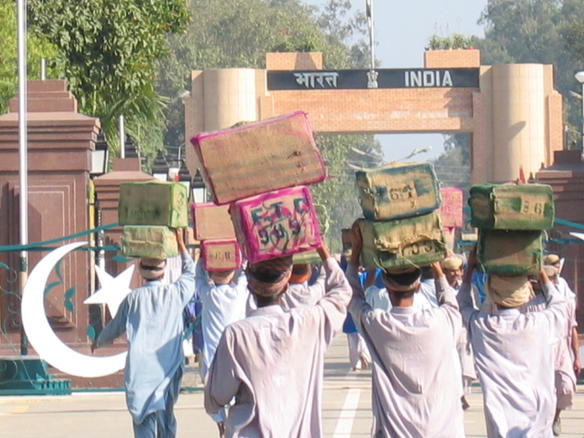
Many of us like to think of country borders as permanent and meaningful. In some cases, these borders are physical, for example, parts of the divide between the US and Mexico. But, in many cases, borders are lines on a map that serve to separate cultures and people that don’t necessarily need to be divided, for example, Punjabi Indians versus Punjabi Pakistanis (same people, just different sides of the fence). In other instances, the concept of a “country” only makes sense to a colonizer, but not to the people who are part of that country. India, for example, could easily be divided into several countries, each with its own language, dress, cuisine, and cultural traditions. On the other hand, parts of Africa could easily supercede their country divides, either because of spillover populations or cultural affinities.

The “country” as nation-state can both unite and separate, but the country as physical border divides. One idea we’ve discussed at Bellagio is the potential of transforming borders into uniters. Imagine the line between two countries that may have had conflicting relationships in the past. Drawing a line in the sand that says "this is mine, that is yours" only further cements the divide. But, what if the line in the sand were made into a park—neutral territory for either side to enjoy, that was classified as neither country’s official domain, but something shared. The concept immediately changes the way one thinks about the border. It is a connector. A few areas are already doing this. If you’re interested, check out the Balkans Peace Park Project and the Great Limpopo Transfrontier Park.

Robots, Pipes, Stampedes, Oh My!


Thirty two people from around the world have gathered in Bellagio to talk about the future. We are part of the Rockefeller Foundation’s “searchlight function,” an effort by the organization to work with teams around the world to uncover new and future developments that will affect the poor. In addition to about 10 sets of researchers, there are an additional 6-7 guests who have been seeded among us to add complexity and alternative perspectives to the conversation. Which is why, at breakfast yesterday, I found myself learning about the way robots can be used to find water leaks inside pipes and detect bank robberies before they happen.

Let me explain. Old leaking and cracked pipes are a big issue in many countries—developed and developing. The last month alone in Mumbai, the media has reported at least 5 major pipe bursts due to festering leaks. Smart robots can actually prevent this from happening by finding current or potential weak spots and patching them up.

As Andre-the-robot-man explained to me, the robots are programmed to sense dissonance in patterns. In the case of a pipe, they can sense when there is a break in the surface because it is different from the other parts of the pipe. The same kind of technology can also be used to identify when a bank is being robbed or when a crowd is getting out of control. The system maps the usual behavior, and when it notices a break in the pattern, it can alert the main system. Think about how useful this would be for crowd situations in India, where there are stampedes several times a year that inevitably cause unnecessary deaths of dozens, and sometimes hundreds of people. The technology developed by Andre’s company can actually detect a simmering situation about 4-6 minutes before it explodes—giving the powers that be time to react and prevent it.

At Bellagio, we are quite far from these realities--Indian stampedes and robots that find leaks--but the peacefulness here makes it surprisingly easy to focus and get on with the thinking.